- Latinometrics
- Posts
- 🗳️ Turnover
🗳️ Turnover
Political tides in Latin America are turning faster than ever.

Latinometrics
October 21, 2025 • Reading time: 3 minutes
A few months ago, most Bolivians probably couldn’t tell you who Rodrigo Paz is. The man even missed the earliest televised presidential debates earlier this year. “An unknown face with a well-known name,” some called him, as the centrist senator and former mayor of Tarija happened to also be the son of former President Jaime Paz Zamora (1989-1993).
Yet Paz is officially set to become Bolivia’s next president, taking office in just over two weeks. His win last Sunday night marks a transition away from the country’s powerful left-wing Movement Towards Socialism (MAS), which has ruled the country almost uninterruptedly since 2006.
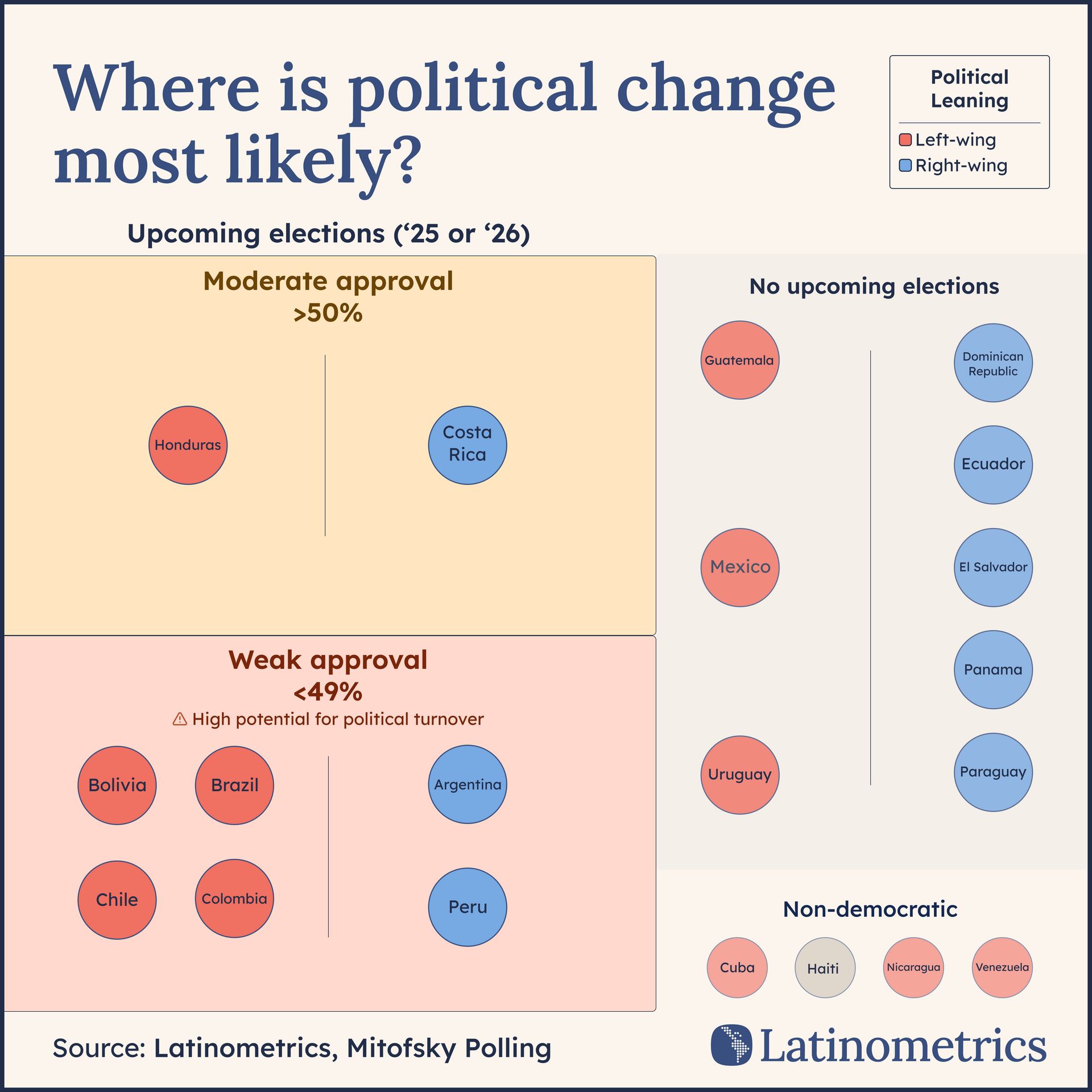
But Bolivia’s unlikely to be the last place where the Latin American left loses in the coming months. We’re in full election season, and many of the most vulnerable presidents are of the left.
Where is political change most likely?
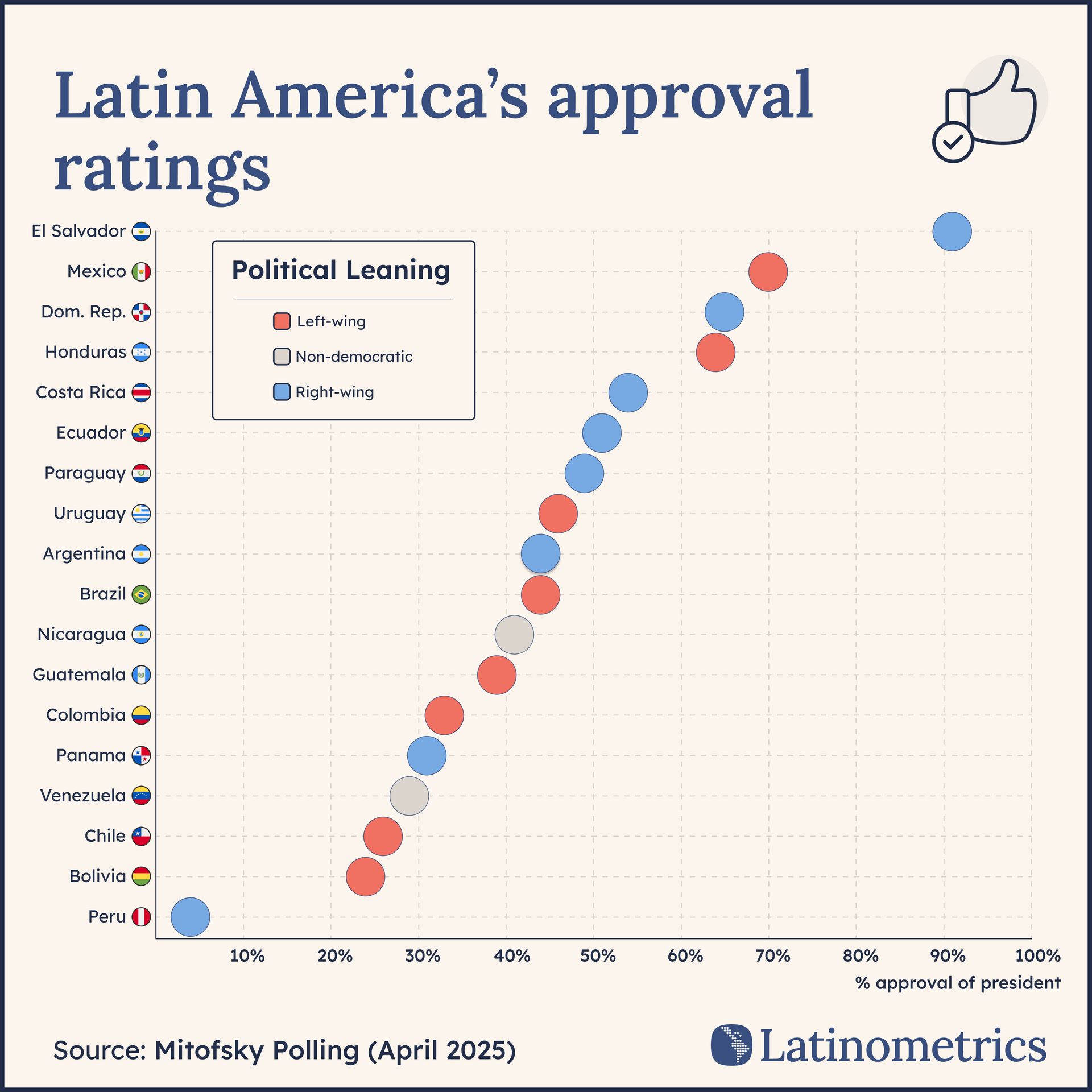
Take Chile and Colombia. Both Gabriel Boric and Gustavo Petro are on their way out, with their stubbornly low approval ratings meaning it’s likelier than not they’ll be replaced by an ideological adversary. The frontrunner in this year’s Chilean election, for example, is ultraconservative José Antonio Kast, who’s about as ideologically far from Boric as possible.
Radical change in the presidency is also likely to be on the menu in neighboring Peru, where one unpopular president after another has been ousted from power by congress. Peru today may be the rare Latin American country heading towards a parliamentary oligarchy, where true power lies not in the executive branch but in the legislature, which would be an anomaly in this region of the world.
Speaking of legislatures, Argentina’s midterms are this Sunday, and everyone’s eyes are on whether President Javier Milei can protest his ambitious agenda from the powerful Peronist opposition which dealt him a blow in a regional election last month.
In addition to his country’s fiscal and monetary stability, roughly $40B in support from the US is on the line for Milei, as US President Donald Trump has conditioned his government’s help on the electoral success of his ideological ally.
But not every leader’s losing sleep over approval ratings.
Latin America's approval ratings
Indeed, the most powerful leaders in Latin America today are those facing neither low approval ratings nor even an upcoming election.
Claudia Sheinbaum of Mexico, Luis Abinader of the Dominican Republic, and especially Nayib Bukele of El Salvador—all of whom won an election (or reelection) last year—are all riding high on their powerful congressional majorities and high popular support.
But of course, even popular leaders are susceptible to the ebb and flow of the Latin American ideological tide. Just ask Brazil’s Lula de Silva, who is debating running for reelection next year after concluding his current third presidential term. The Lula who left office in 2010 was certainly not the same Lula who won a narrow victory in late 2022—and the Lula of next year would likely face an even bigger challenge.
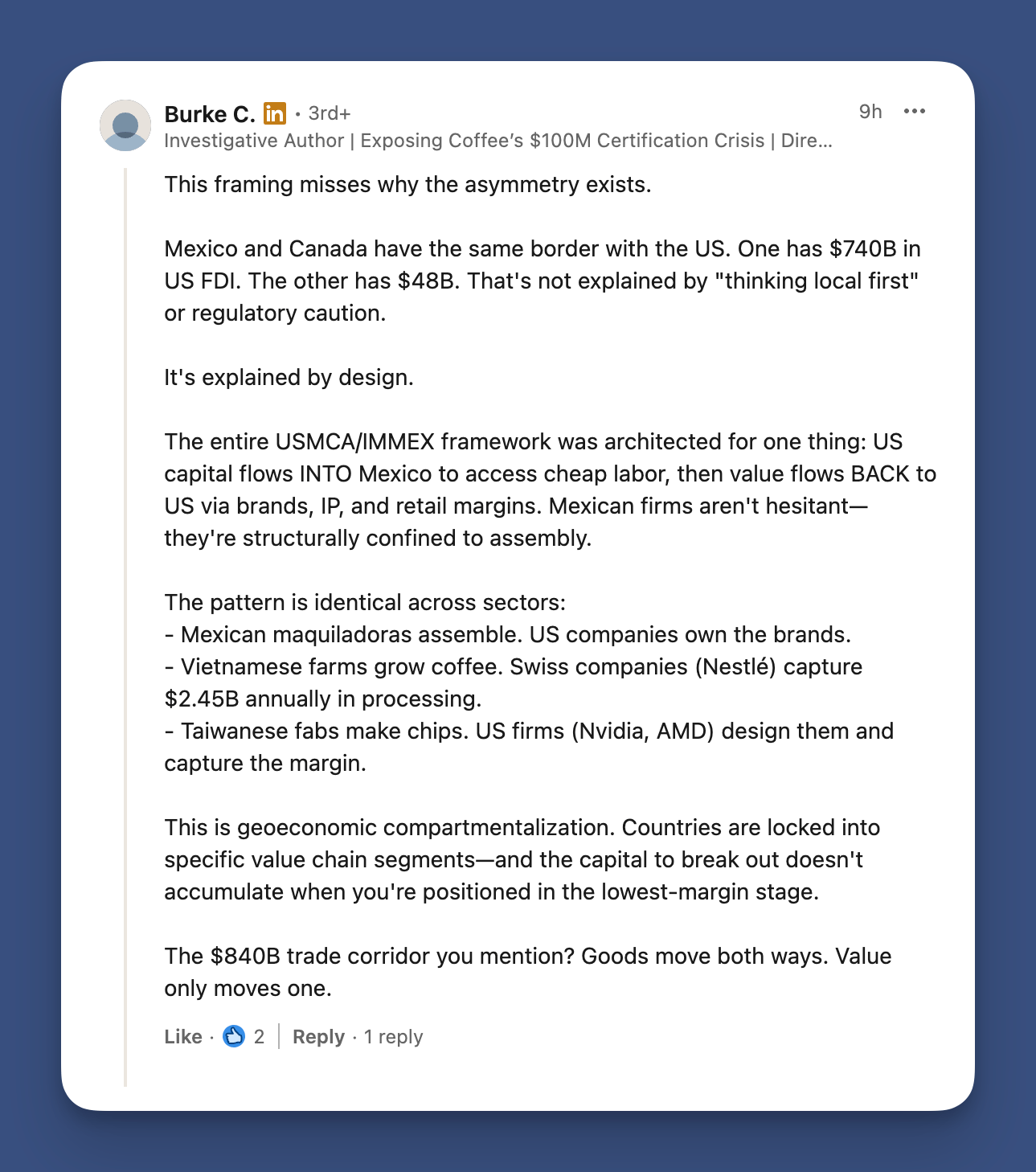
Burke summarizes a perspective not uncommon in Latin America: That trade is a net negative for the countries with cheap labor.
Feedback or chart suggestions? Reply to this email, and let us know!
Join the discussion on social media, where we’ll be posting today’s charts throughout the week.
Comment of the Week 🗣️